
To More Inquiry
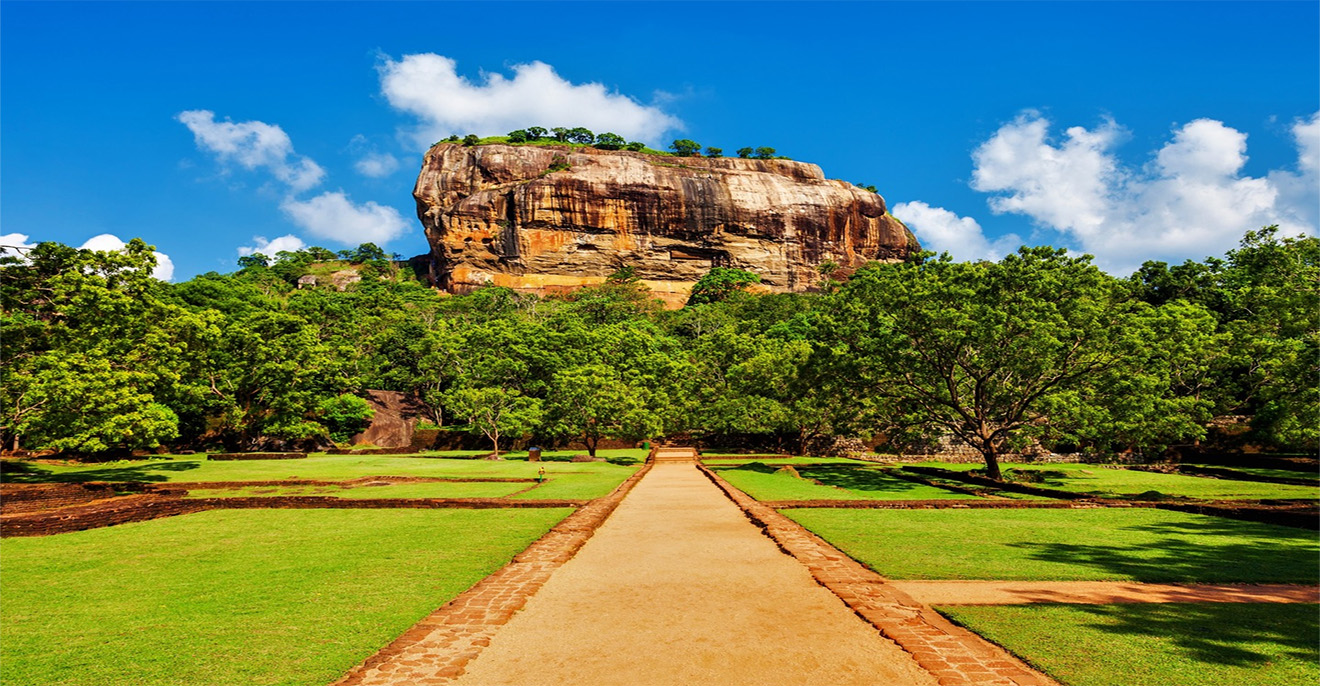
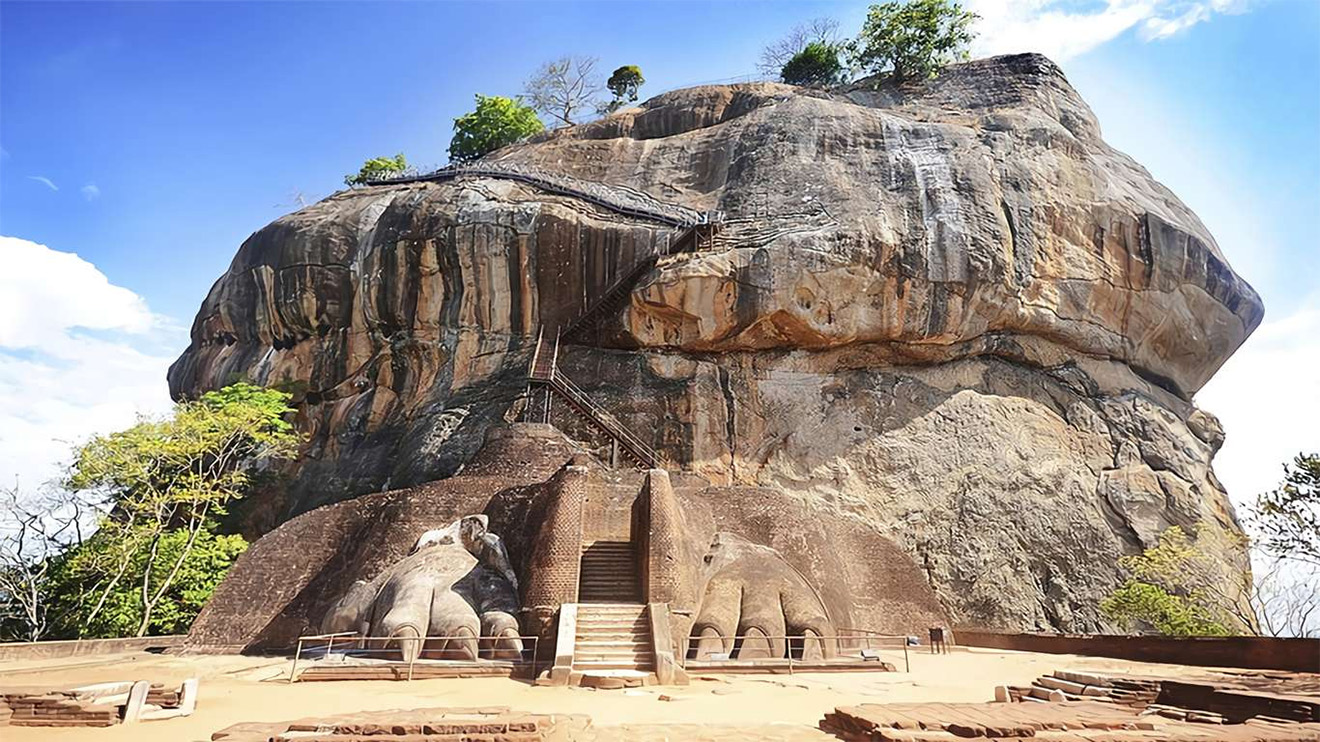
The World Heritage Site of Sigiriya refuses to reveal its secrets easily, and you'll have to climb a series of vertiginous staircases attached to sheer walls to reach the top. On the way you'll pass a number of quite remarkable frescoes and a pair of colossal lion's paws carved into the bedrock. The surrounding landscape - lily-pad-covered moats, water gardens and cave shrines - only add to Sigiriya's rock-star appeal.
Peppered with natural cave shelters and rock overhangs supplemented over the centuries by numerous hand-hewn additions and modifications Sigiriya may have been in- habited in prehistoric times. The rock itself is an ancient magma plug from a long-ago-eroded volcano. The established historical theory is that the rock forma- tion served royal and military functions during the reign of King Kasyapa r 477- 495), who built a garden and palace on the summit. According to this theory, King Kasyapa sought out an unassailable new resi- dence after overthrowing and murdering his UMO father, King Dhatusena of Anuradhapura. After 16 years on the throne Kasyapa eventually took his life on the battlefield, follow- ing the return of his vengeful half-brother. UMO After the 14th century the complex was abandoned. British archaeologist HCP Bell re- discovered the ruins in 1898, and they were further excavated by British explorer John Still in 1907.
The base of the Sigiriya rock is a beautifully land- scaped garden area dotted with formal tures, terraced gardens and natural boulders that water fea- were once home to numerous Buddhist shrines. It's a beautiful place to explore away from the crowds. From the main entrance you pass a series of sym- metrical water gardens, which extend to the foot of the rock and include bathing pools, little islands with pavilions that were used as dry-season palaces, and landscaped borders. A series of steps continues up through terraced gardens to the western face of the rock, and then as- cends it steeply. The charming boulder gardens, closer to the rock itself and best seen on the descent from the rock, fea- ture boulders that once formed the bases of monas- tery buildings. The step-like depressions in the sides of the boulders were the foundations of brick walls and timber columns. The cistern and audience-hall rocks are impressive, and the entire area is fun to explore. The rocky projection known as the Cobra Hood Cave earned its name because the overhang resem- bles a fully opened cobra's hood. The plastered terior of the cave was once embellished with floral in- and animal paintings; a couple of faint traces re- main. Below the drip ledge is an inscription from the 2nd century BC that indicates it belonged to Chief Naguli, who donated it to a monk. Because this cave lies off the route leading up to the rock, you generally pass by this cave after descending from the summit on your way to the south gate and the car park.
Halfway up the Sigiriya rock an open-arr spiral stair- way leads to a long, sheltered gallery of frescoes decorating the sheer rock face. The paintings of the buxom, wasp-waisted women are popularly believed to represent either apsaras (celestial nymphs) or King Kasyapa's concubines. Protected from the sun in the Sheltered gallery, the frescoes remain in remarkably good condition, their colours still glowing. Modern theory suggests the female forms repre- sent aspects of Tara a bodhisattva and one of the most important figures in Tantric Buddhism. They similar in style to the rock paintings at Ajanta are in India, but haye a specific character in their clas- sical realist style, No one knows the exact dates of the impressive frescoes, though it's unlikely they date far back as the 5th century (when King Kasyapa ILS reigned). The paintings are at their best in the late-afternoon light. Photos are not allowed. Beyond the Sigiriya frescoes, the path inches along the sheer side of the rock and 1S protected on the outside by a 3m-high wall, T'his so- called mirror wall (not the actual rock face) was coated with a smooth glaze upon which visitors felt impelled to note their impressions of the women in the gallery above or so says local leg- end. The graffiti was inseribed between the 6th and 14th centuries, look hard beyond the modern mess to see the ancient messages. The graffiti is ofgreat interest to scholars because they show the development of You'll have the Sinhala language and script, and because they demonstrate an age-old appre- ciation of art and beauty.
At the northern end of the rock, a narrow pathway emerges on to the large plat- form from which the site derives its name Sigiriya (from sinha-giri) means 'Lion Rock' HCP Bell, the British archacologist responsible for an enormous amount of archacology in Sri Lanka, found the two enormous lion paws when excavating here in 1898 (pictured on previous page). At one time a gigantic brick lion sat at this end of the rock, and the final ascent to the top commenced with a stairway that led between the lion's paws and into its mouth. The lion symbolism serves as a reminder to devotees ascending the rock that Buddha was Sakya-Sinha (Lion of the Sakya Clan) and that the truths he spoke of were powerful as the sound of a lion's roar. The 5th-century lion has since disappeared, apart from the first steps and the paws. Reaching the top means clambering up across a series of metal stairs, but you can still see the original grooves and steps cut into the rock.
The spectacular terraced summit of the rock covers 1.6 hectares. This is thought to be the site chosen by King Kasyapa for his fortified capital. Today only the low oundations of structures exist, and the remains are visually unimpressive. Still it's hard not to be captivated by the astonishing views from this lofty perch, which extend for kilometres across an emerald ocean of forest. A smooth stone slab (the so-called king's throne, possibly a meditation spot) sits 30m away from the ruins of a dagoba. The 27m-by-21m tank, hewn out of the rock, looks for all the world like a modern swimming pool, although it was doubtless used for water storage.
This decent museum (C7.30am-5pm) has a fine diorama of the site, providing an excellent overview and explaining Sigiriya's cultural importance beyond the obvi- ous natural beauty, Trade routes are explained, showing Sigiriya's connections with the Gulf, China, India and the Roman Empire. Look for the wonderful black-and-white photos of British archaeologist HCP Bell and his somewhat reluctant family exploring the site soon after its rediscovery. The museum is near the eastern entrance to the site. If you are visiting Sigiriya in the morning, visit the museum after ascending the rock to avoid the heat of midday, If visiting the afternoon, visit the museum before ascending in the cool of the late afternoon.